
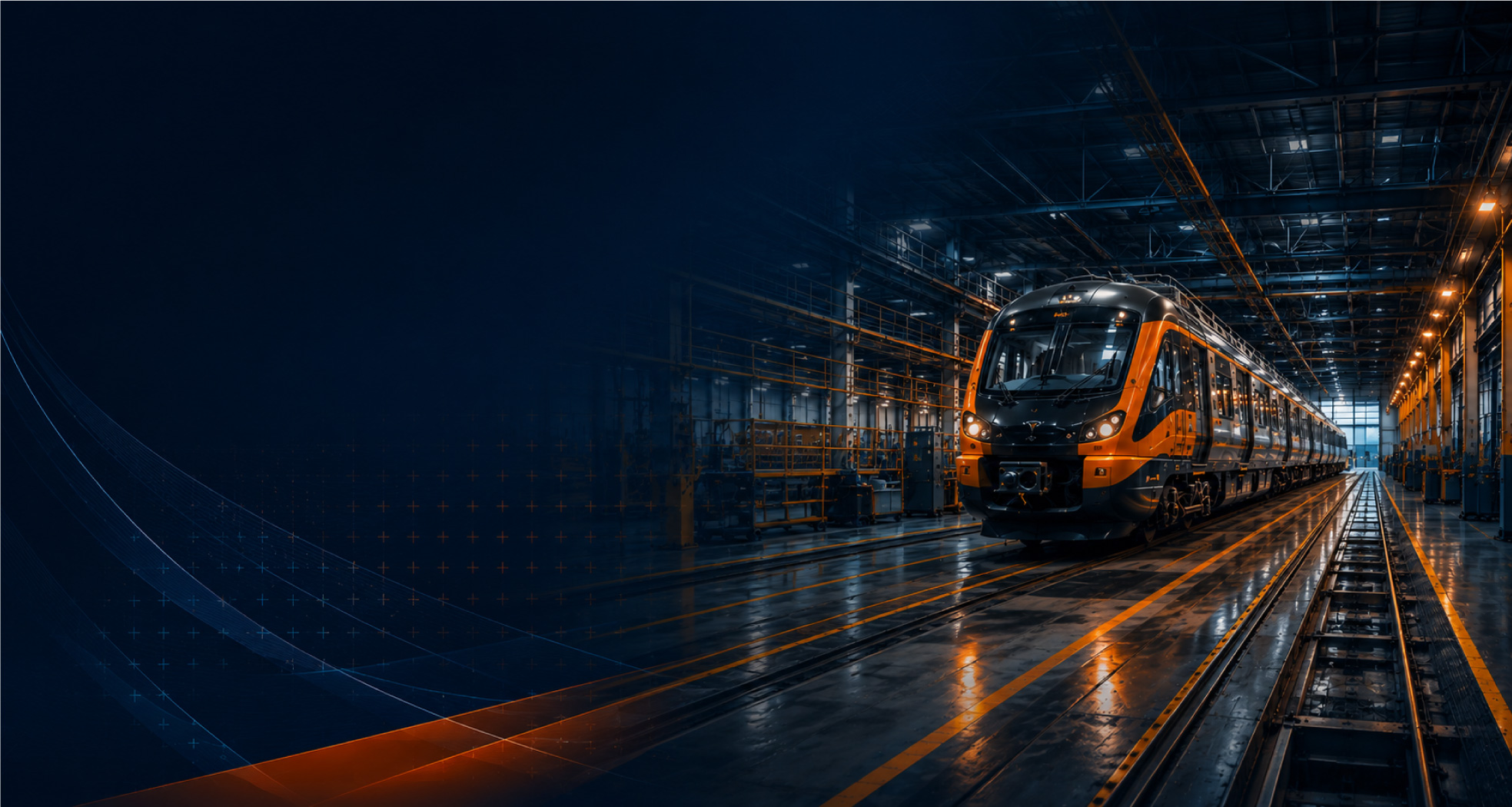
Across the rail industry, significant investment is being made in new rolling stock, infrastructure and technology. At the same time, the facilities responsible for maintaining those trains and preparing them for service are becoming increasingly sophisticated operational environments.
Modern depots bring together people, rolling stock, plant, infrastructure and multiple safety-critical systems, often within constrained sites operating around the clock. They are no longer simply places where trains are maintained; they are strategic assets that directly influence fleet availability, service reliability and ultimately the passenger experience.
As depots evolve, we believe the way the industry thinks about depot safety and control needs to evolve with them.
Moving beyond standalone protection
Historically, depot protection systems have often been viewed primarily as safety systems: protecting personnel working on or around rolling stock and preventing unauthorised vehicle movements.
Those fundamental requirements have not changed. Protecting people must always remain the primary objective.
What has changed is the operational environment around them.
Operators increasingly need greater visibility of what is happening across their facilities, while coordinating vehicle movements, maintenance activities, workforce access and an expanding range of depot equipment.
Modern depots can include points systems, depot doors, lifting jacks, wheel lathes, shore supplies, fuelling equipment and other specialist plant. Each may have its own operational and safety requirements, but they do not necessarily operate independently of one another.
Managing those interfaces through separate, disconnected systems can introduce additional complexity.
The opportunity is therefore to think more holistically about how protection, control and operational management work together.
Safe operations are efficient operations
Safety and operational efficiency are sometimes discussed as though improving one inevitably compromises the other.
Our experience suggests the opposite.
A well-designed safety and control environment can remove uncertainty from depot operations. Personnel know when it is safe to work, operators have greater visibility of activities across the facility, and movements and equipment can be appropriately controlled and interlocked.
When staff have confidence in the systems around them, they can concentrate on carrying out their work rather than managing avoidable uncertainty and risk.
In that sense, safe operations are efficient operations.
This does not mean pursuing productivity at the expense of safety. It means recognising that good safety systems can enable efficient operations rather than obstruct them.
The objective should be to create an environment where safety is embedded within the way the depot operates.
The value of integration
One of the most important developments we see is the increasing integration of safety and control.
Depot Protection Systems, Depot Control/Locally Operated Points Systems (LOPS), Personnel Warning Systems and Interlocking Solutions can increasingly form part of a coordinated operational environment.
Technologies such as Radio Frequency Identification (RFID), intelligent interlocking, remote monitoring and supervisory control can provide additional layers of protection while giving operators greater visibility of depot activities.
The potential benefits extend beyond workforce protection.
Greater integration can help reduce operational uncertainty, improve visibility, simplify the management of depot activities and enable faster identification and diagnosis of faults. It can also help operators understand the status of infrastructure and equipment and make better-informed operational decisions.
This is particularly important as the number of interfaces within depots continues to increase.
The objective, however, should not simply be to connect technology for technology’s sake. Integration needs to deliver a clear operational benefit.
Technology should support people
There is a temptation when discussing the future of rail to focus almost exclusively on technology.
Digitalisation, automation, intelligent diagnostics and data will undoubtedly play increasingly important roles in depot operations. But technology alone does not create a safe or efficient depot.
People remain at the centre.
Every depot is different. The way vehicles move around the facility, the maintenance activities undertaken, the infrastructure available and the interaction between different teams will vary from site to site.
That is why we believe understanding the operation must come before designing the solution.
Rather than asking how a depot can be adapted to fit a particular technology, the starting point should be: how does this depot need to operate, what are the risks and operational challenges, and how can technology best support the people managing them?
The most effective solutions bring together people, processes and technology.
No such thing as a standard depot
This becomes particularly important when existing facilities are modernised.
Unlike a new-build depot, where systems can potentially be considered as part of the overall facility design, established depots often need to accommodate new rolling stock, equipment or maintenance processes within existing infrastructure.
That creates a different set of challenges.
At Transport for Wales’ Canton Depot, for example, FirstClass Safety & Control has delivered multiple phases of depot protection and depot control work supporting the site’s transformation for a modern fleet.
The solution has had to interface with a wide range of equipment and operational systems across maintenance roads, stabling facilities and specialist maintenance areas.
The wider lesson is not about one particular project or technology. It is that successful depot safety and control starts with understanding how the facility actually works.
There is no universal solution because there is no standard depot.
What will the depot of the future look like?
The direction of travel is clear.
Depots are likely to become increasingly connected, automated and data-driven. Operators will expect greater real-time visibility of their facilities, while remote monitoring, enhanced supervisory systems and intelligent diagnostics provide more information about the status and performance of equipment.
At the same time, new rolling stock technologies and changing maintenance requirements will continue to reshape depot operations.
This presents an opportunity to think differently about the information generated by safety and control systems.
Rather than considering individual systems in isolation, the industry can increasingly consider how appropriate information and control can contribute to a more complete operational picture of the depot.
But greater sophistication must not create unnecessary complexity for the people using these systems.
The measure of successful technology is not how advanced it appears. It is whether it makes an operation safer, clearer and more manageable.
Protecting people, assets and infrastructure
Whatever technologies emerge, the fundamental purpose of depot safety and control will remain unchanged.
People need to be protected. Assets and infrastructure need to be safeguarded. And operators need confidence that their facilities can support reliable railway operations.
What is changing is our ability to achieve those objectives in a more integrated way.
The future should therefore not simply be about adding more technology to depots. It should be about using technology intelligently to create environments in which protection, control and operational visibility work together.
As the railway invests in new fleets and increasingly sophisticated maintenance facilities, we believe depot safety and control deserves to be considered as an integral part of that transformation.
Because the safest depot should not be the one where safety systems make operations more difficult.
It should be the one where good safety and good operations have become inseparable.
That is what we mean when we say: safe operations are efficient operations.